Machine VisionFPGAComputer Vision
INDUSTRIAL MACHINE VISION
ACCELERATE THE REALIZATION OF INTELLIGENT VISION
Cameras and other devices for video surveillance and machine vision can perform a variety oftasks, such as image signal processing(SP),
video transmission, format conversion , compression, and analysis. With the continuous technical upgrade of camera sensors,
intelligent Internet protocol cameras gradually replace analog cameras, and with the significant progress of video analysis based
on in-depth learning of artificial intelligence, FPGA exceeds the main requirements of vision-based systems:
> higher performance and power consumption ratio.
> Low delay.
> Flexibility.
Combined with CPU, FPGA-based accelerator solutions now support the
architectural redesign of the next generation of vision-based devices.
MACHINE VISION
In addition to digital image acquisition and analysis, machine vision (MV) also uses high-speed cameras and computers to perform
complex inspection taskS. You can use the resulting data for pattern recognition, object sorting, manipulator control, and so on.
FPGA is suitable for MV cameras, enabling the design to adapt to a varietyof image sensors and MV specific interfaces.
FPGA canalso be used as a visual processing accelerator in the edge computing platform to enhance the ability of artificial intelligence to
deeply learn and analyze MV data.
With machine vision (MV) technology, you will no longer need to manually check quality control.MV technology combines high-speed
camera and computer to complete the complex inspection task on the basis of digital image acquisition a
resulting data for pattern recognition, object sorting, manipulator control, and so on.MV applications incl
> Defect detection.
> measurement.
> Navigation, component tracking and identification.
> Optical character recognition and verification (OCR/OCV)
> Pattern recognition.

> Packaging, product, surface and network inspection.
AD ADVANTAGE-PERFORMANCE,FLEXIBILITY AND CONNECTIVITY
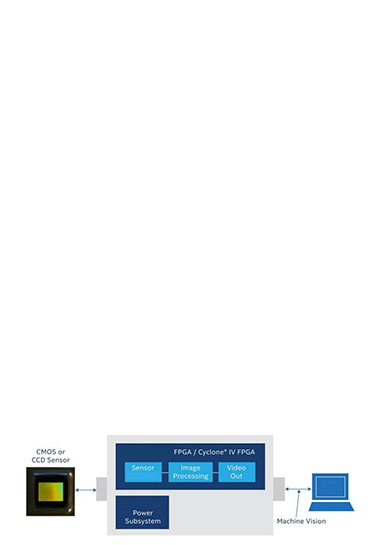
As shown in the figure below, FPGA, can help MV designers
> High-performance image preprocessing (using protocols such as Camera Link)on the frame grabber board for real-time frame rates.
> Integrate real-time capabilities into the camera system for pivel-oriented gain control, defective pixel compensaton, and dynamicrange expansion,and more.
> Leverage the flexibility of FPGAs to support evolving camera interfaces.
> lmplement various bus interfaces, such as PCI', PCle*, Gbps Ethernet. USB, etc.
> Integrate multiple functions such as image acquisition, camera interface, preprocessing and communication functions on a single FPGA.
> Using Cyclone' V SoC, combine your image signal processing pipeline and execute machine vision algorithms of ARM AS hard core
processor system to develop a complete machine vision system-on-chip.
> Generate C/C++t code for Cyclone'VSoC using MathWorks' Simulink and Embedded Coder.When combined with HDL Coder's SoC
support, the solution can be used for hardware/software workflows including on-SoC simulation, prototyping, verification
and implementation.Visit the MathWorks page for more information.
FLEXIBILITY-FPGA SUPPORTSA VARIETY OF SENSORS AND MV INTERFACES
GIGEVISION
GigE Vision provides an open, high-performance extensible framework that supports image flow transmission and device control over Ethernet.
This interface standard provides an environment for networked machine vision systems rich in switching client / server architecture to
enable you to connect multiple cameras to multiple computers.
lt includes the following features:
> Specification for the management of the automatic Imaging Association(AIA).
> The protocol implemented on Ethernet / IP/UDP uses Gbps Ethernet, the upwelling rate of data
transmission is as high as 1Gbps, and 10-Gbps Ethernet is used, which can be extended to 10 Gbps.
> The data transmission length is up to 100 meters when using the network line.
> Use switches, medium and absolute switches, or optical fiber conversion to extend data transmission long building.
> Use low-cost cables(CAT5e or CAT6), standard connectors, and hardware.
AN EXAMPLE OFAGIGE VISUAL APPLICATION USING MULTIPLE GIGE CAMERAS
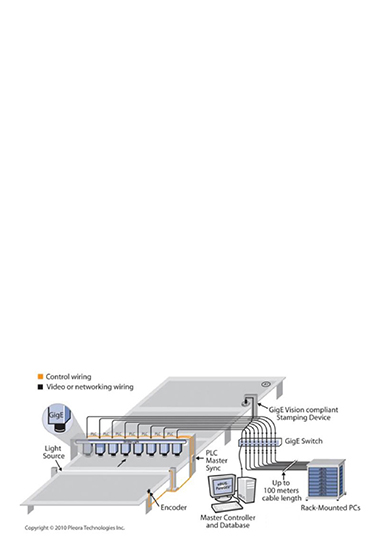
By Pleora Technologies lnc. Provide
You can implement GigE Vision applications using FPGA, such as the MAX*10 FPGA Cyclone
"IV.Cyclone' V device family," to gain a numberof major advantages:
> Integrate image acquisition, camera interface , preprocessing and communication functions on a single FPGA device.
> With the evolution of the product, it flexibly supports various camera interfaces and bus interfaces.
> Smaller motherboards, fewer components, and minimal hardware rework, resulting in lower total cost of ownership (TCO).
> Long FPGA life cycles and easy migration to the latestFPGA families reduce the risk of product obsolescence.
FOR MORE INFORMATION, PLEASE CONTACT YOUR CUSTOMER SERVIC
FRAME GRABBER
Frame grabber link between MV camera and host PC(running machine vision algorithms).Current versions
typically use PCle to transfer the view from the camera to the main processor in an industrial computer.
CAMERA LINK
CameraLinkis a serial communication protocol designed to support point-to-point automated visual applications.
The Camera Link specification, supported by the Automated lmaging Association(AlA), standardizes camera interfaces, cables,
and frame grabbers for converting and transferring camera data to acomputer, typically via the PCITM or PCLe* bus. You
willfind the Camera Link interface suitable for applications such as machine vision systems and smart cameras.
> Camera Link supports multiple configurations:
> The base configuration uses 24 bits of piel data (and 3 bits of video sync data) to achieve a maximum video throughput of 255 Mbps.
> The medium configuration adds another 24 bits of data for a maximum video throughput of 510 Mbps,
> Full and extended configurations use 64-bit (or wider) data for a maximum video throughput of 680Mbps (or greater),
ADVANTAGES OF USING FPGAS IN CAMERA LINK APPLICATIONS
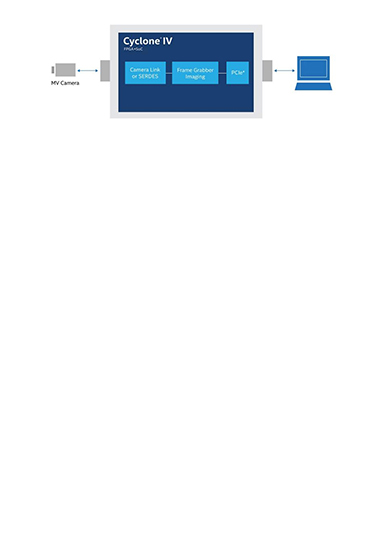
As shown in the figure below, you cantake advantage of low-cost PGAs such as Cyclone" IV.Cyclone'V devices to create high-performance
Camera Link applications,reducing yourtotal cost of ownership (TCO) and improving return on investment (ROl). If you need further For
improved performance, Intel's ArriaV GX or Stratixe V FPGAs can be used.
CAMERA LINK APPLICATION EXAMPLE USING CYCLONElV FPGA

With FPGA, you can:
> Acelerate inmage preprocessing lsuch as piellocationgain control, defect piel compensation, and a larger dynamic range)to achieve real-timeframe rate.
> lmage acquisition, camera interface, preprocessing and communication are integrated on a single FPGA device.
> As various camera / bus / communication interfaces evolve, these interfaces are supported in your design (no new hardware is required).
> Reduce the size of the motherboard, reduce the number of components, minimize hardware remake, bring the
product to market as soon as possible, so that the product has alonger life cycle in the market,thus reducingyour Tco.
For more information, please contact your local Intel Reseller sales Office or visit ourindustrial partners.
USB 3 VISION
There are many advantages to usingUSB 3.0: the redundancy , low cost, up to 5 Gbps transmission rate, low power consumption,
and CPU overhead of theUSB 3 interface on the current PC, and the integration of data and power on a single cable up to 5
meters long without an active repeater.
CoaXPress
CoaXPresshas a transmission rate of up to 6.25 Gbps per cable and supports up to 130m long cables. Quad link cables and connectors
supportup to 25Gbps transmission rates and enable igh-performance cameras to complete stringent high-bandwidth connections.
Supports a combination of single, dual, or four cameras and can be managed with cards that support a four-link CoaXPress interface.
Thunderbolt
Thunderbolt "supports up to l0Gbps transmission rates, and Thunderbolt 2 supports up to 20 Gbps transmission rates. The interface
was originally deployed on Aople computers and laptops, and has become more widelyused as more chipsets and PC motherboards
use these high-performance links. lts advantages are the same as USB 3.0, but the transmission rate is higher, and copper or
optical cables are available.
VIDEO SURVEILLANCE
Governments, municipalities, financial institutions and businesses use video surveillance more for image recording and ex post facto
analysis.Artificial intelligence(Al) provides real-time, automatic and feasible insight into the data flow of multiple field cameras.
These technological advances are transforming innovations that go beyond crime prevention / safety into new market business
models, such as retail asset management and more efficient industrial intelligence factories.
The challenge for camera manufacturers is how to insert "smart / analysis" features into end-to-end video solutions. Some "simple"
intelligent features are implemented on low-power,low-cost intelligent Internet Protocol (P) cameras.Complex analysis functions
can be implemented "near the edge" through internal gateways or network video recorders (NR) that support multiple field camera
data streams. Entermprise-level analysis can be implemented using a wide range of cloud-based computing resources.Iin general,
digital high definition (HD)IP sunvellance cameras are replacing analog cameras because of their low installation cost, scalability,
and the ability to add intelligent features. From cameras to the cloud, Intel Vision products offer a variety of solutions and include
analysis based on the latest Al in-depth learning.
FPGA plays an important role in these next generation HD IP cameras and NVR:
> Support Al deep learning framework, model and topologyto implement FPGA-based convolution neural network (CNN) reasoning accelerator
> flexibly connect multiple types of image sensors.
> Fast processing to integrate full lmage Sensor Pipeline (ISP) intellectual property (IP) including
techniques such as defective pixel correction, gamma correction, dynamic range correction, and noise suppression.
> Cost-effective solution with features such as sensor connectivity, image compression, and pan,tilt and zoom(PTZ) control.
Related Links